Scheduled Maintenance List
The Scheduled Maintenance List is your central control panel for all preventive maintenance activity in DreamzCMMS. From a single page, you can see every active PM scheduler across your facilities, monitor their status, search and filter by asset or scheduler type, and take actions such as copying, editing, activating, deactivating, or deleting schedulers — keeping your entire preventive maintenance program organized and running on time.
Overview
Every PM scheduler you create — whether time-based or metered — appears as a row in the Scheduled Maintenance List. This gives managers and planners a complete, at-a-glance view of what is scheduled, for which assets, how frequently, and whether each scheduler is currently active.
This page covers the time-based Scheduled Maintenance list. If you are looking for metered schedulers, navigate to Scheduled Maintenance → Metering Scheduled Maintenance. See How to Create a Metered Scheduled Maintenance
How to Access the Scheduled Maintenance List
Step 1 – Navigate to Scheduled Maintenance
From the left-hand navigation menu, click on Scheduled Maintenance, then select Scheduled Maintenance from the submenu.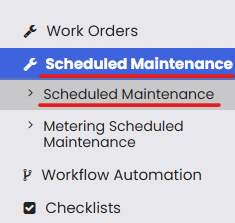
Step 2 – View the List
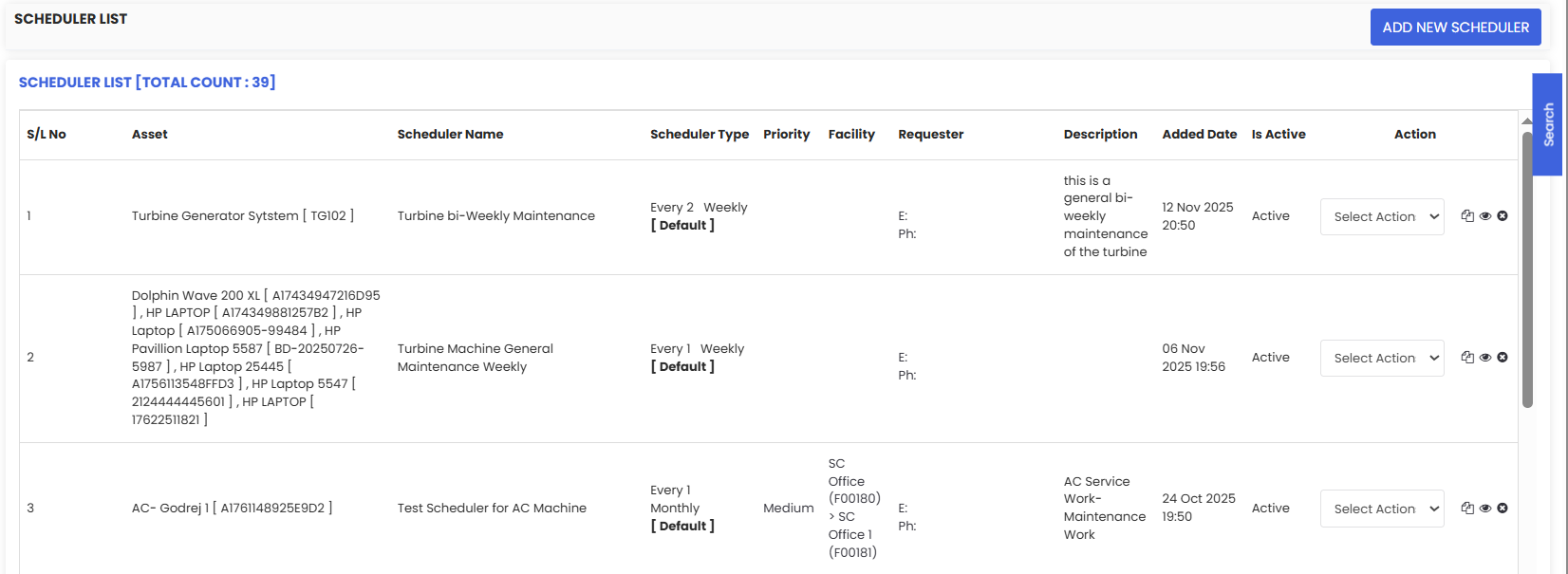
You will be taken to the Scheduled Maintenance List page, showing all existing PM schedulers in your system.
Understanding the Scheduled Maintenance List
Each row in the list represents one PM scheduler and displays the following information:
- Asset / Facility — The equipment or location the scheduler is assigned to.
- Scheduler Name — The name given to the scheduler when it was created. This also becomes the work order title for generated work orders.
- Scheduler Type — Whether the scheduler is time-based (calendar interval) or meter-based (usage threshold).
- Frequency — How often the scheduler generates work orders (e.g., Daily, Weekly, Monthly, or a custom interval).
- Priority — The priority level assigned to work orders generated by this scheduler (e.g., Low, Medium, High, Critical).
- Requester — The user who created the scheduler.
- Description — A brief summary of the maintenance task.
- Added Date — The date the scheduler was created.
- Status — Whether the scheduler is currently Active (generating work orders) or Inactive (paused).
Actions Available from the List
From the Scheduled Maintenance List, you can perform the following actions on any scheduler:
Search and Filter
Use the search bar and filter options at the top of the list to quickly find schedulers by asset, scheduler name, type, status, or frequency. This is especially useful when managing a large number of schedulers across multiple facilities.
Copy a Scheduler
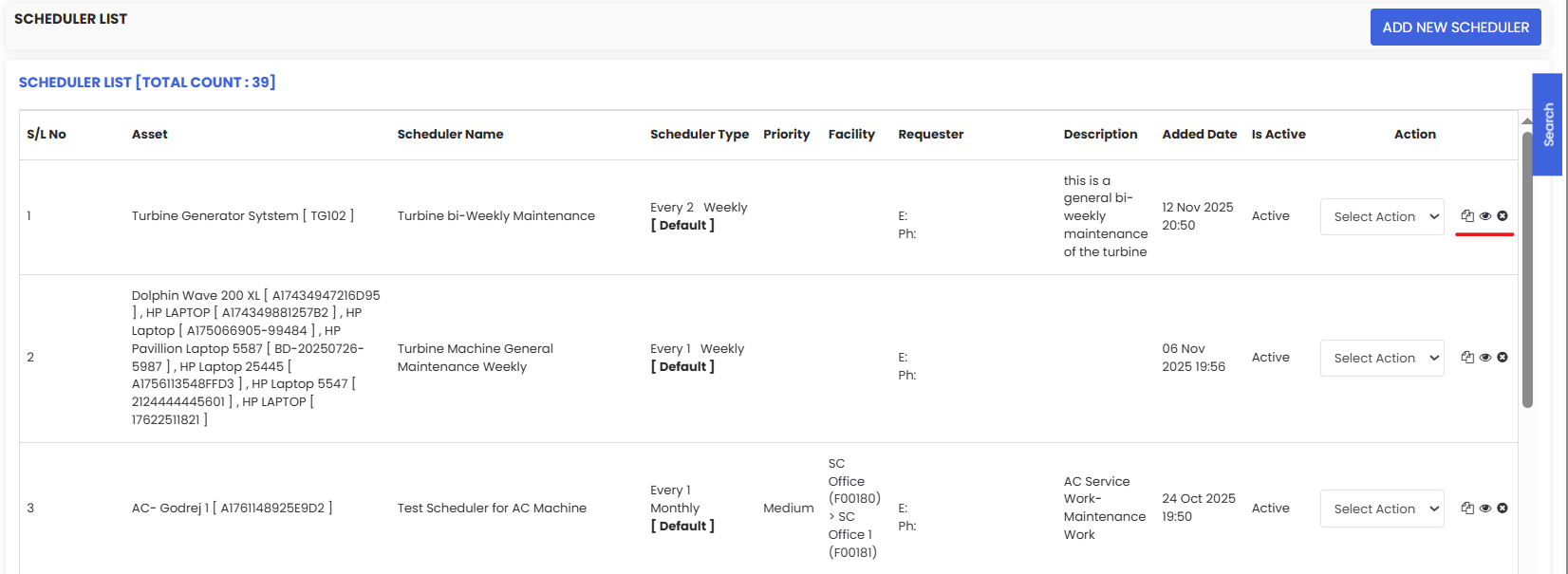
Click the copy icon next to a scheduler to duplicate it. This is useful when you need to create a similar scheduler for a different asset — copy an existing one and update only the relevant details rather than starting from scratch.
Activate / Deactivate
Use the activate/deactivate toggle to pause or resume a scheduler without deleting it. A deactivated scheduler stops generating new work orders but retains all its configuration, so it can be reactivated at any time.
Tip: Use deactivate instead of delete when a scheduler is temporarily not needed — for example, during a planned shutdown or when an asset is under repair. This preserves the scheduler history and saves you from recreating it later.
View Scheduler / History
Click View on a scheduler to open its full details and see the history of all work orders it has generated. This gives you a complete record of past PM activity for that scheduler.
Edit or Delete
Use the Select Action dropdown on a scheduler to:
- Edit — Modify the scheduler's name, frequency, assigned asset, work order details, or any other setting. Changes apply to future work orders only — any work orders already generated are not affected.
- Delete — Permanently remove the scheduler. This action cannot be undone. All future work order generation for this scheduler will stop. Previously generated work orders are not deleted.
Note: Deleting a scheduler is permanent. If you only need to pause it temporarily, use Deactivate instead.
Tips for Managing Your Scheduled Maintenance List
- Review your list regularly — A quarterly review of all schedulers helps ensure frequencies are still appropriate, assets are still in service, and nothing has been left active unnecessarily.
- Use Copy to speed up setup — When rolling out PM schedules for similar assets (e.g., multiple identical pumps or HVAC units), copy an existing scheduler and update only the asset assignment.
- Keep scheduler names consistent — A clear naming convention (e.g., "Frequency – Asset – Task") makes the list much easier to scan and filter (e.g., "Monthly – HVAC Unit 3 – Filter Change").
- Monitor status column regularly — Ensure all schedulers that should be active are showing as Active. Schedulers that were accidentally deactivated will silently stop generating work orders.
- Use filters before bulk actions — When managing large numbers of schedulers, use the filter options to narrow down the list before making changes to avoid editing the wrong records.
Frequently Asked Questions
How do I create a new scheduler from this page?
Click the Add New Scheduler button in the top-right corner of the Scheduled Maintenance List.
What is the difference between deactivating and deleting a scheduler?
Deactivating pauses the scheduler — it stops generating new work orders but retains all configuration and history, and can be reactivated at any time. Deleting permanently removes the scheduler and cannot be undone. Always prefer deactivating unless you are certain the scheduler is no longer needed.
Where can I see all the work orders a scheduler has generated?
Click View on the scheduler to open its detail page, where you can see the full history of all work orders it has generated.
Can I edit a scheduler that is currently active?
Yes. Editing an active scheduler does not stop it — changes take effect from the next work order generation onwards. Any work orders already generated and in progress are not affected.
Why is my scheduler not generating work orders?
Check the Status column to confirm the scheduler is set to Active. Also, verify that the start date has passed and that the frequency settings are configured correctly.
Where do I manage metered schedulers?
Metered schedulers are managed separately under Scheduled Maintenance → Metering Scheduled Maintenance.
Related Articles
- Create and Manage Work Orders
- How to Add Meter Readings and Event Details for Equipment
- How to Manage Various Asset Information
- Create Asset Locations
- How to Add BOM to a Facility/Location