Invoice Fields Configuration
Invoice Fields Configuration gives administrators full control over the invoice form, line-item display, and list view in DreamzCMMS. By tailoring which fields are Required, Optional, or Hidden, you enforce data quality and simplify the invoicing process for your team. The companion Invoice Inventory Configuration controls which line-item details appear on invoices, while Invoice Columns Configuration lets you customise the invoice list view to surface the information most relevant to your workflow.
Overview
The Invoice Configuration covers three distinct areas:
- Invoice Fields Configuration — Controls which fields appear on the invoice form and whether each is mandatory, optional, or hidden.
- Invoice Inventory Configuration — Controls which line-item details (e.g., Unit, Tax, Warranty) are displayed or hidden on invoice line items.
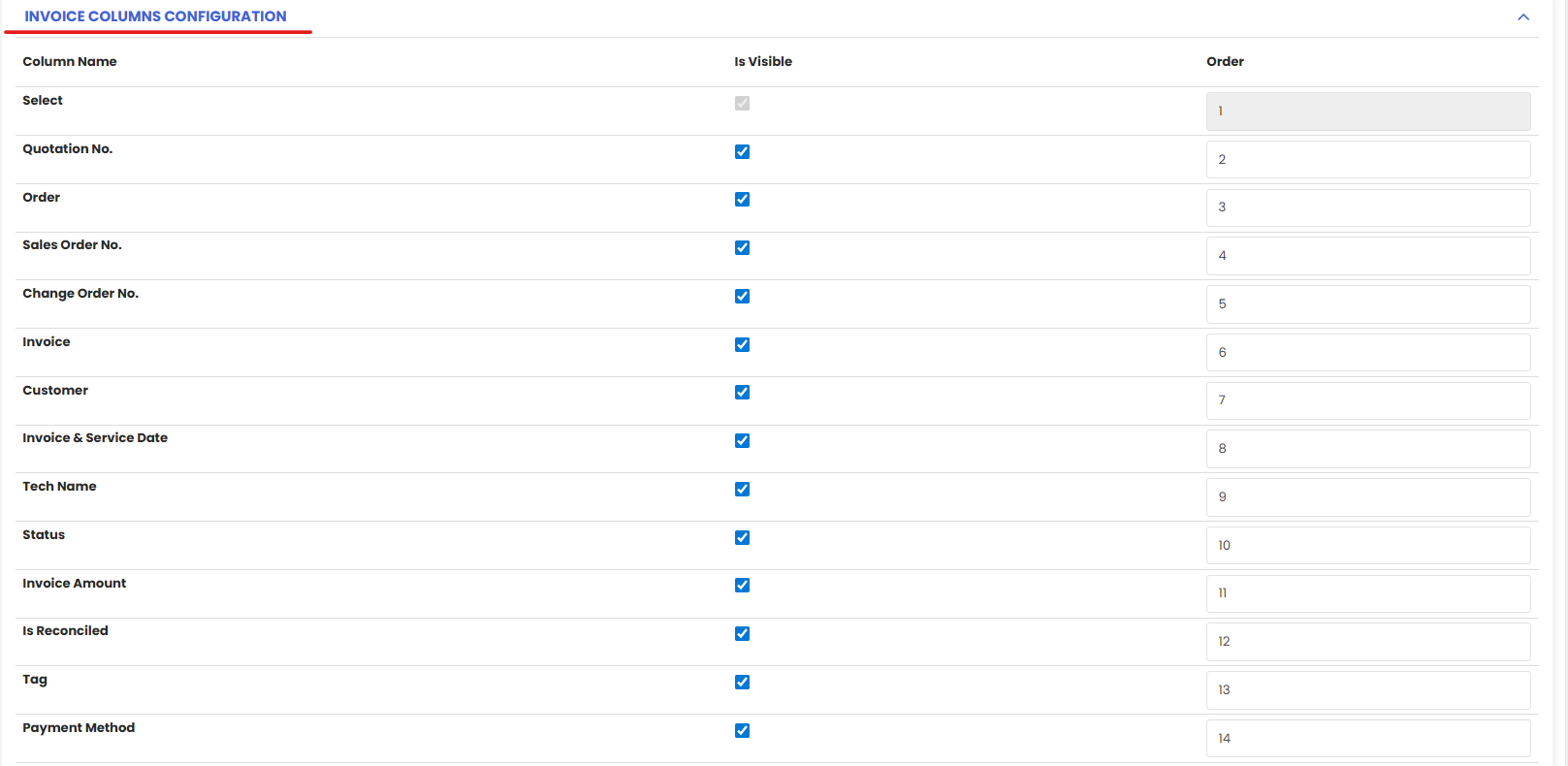
- Invoice Columns Configuration — Controls which columns are visible in the Invoice list view and the order in which they appear.
All three are managed from the Invoice Configuration tab inside System Configuration.
Before You Begin
- You must have Admin permissions to access and modify Invoice Fields Configuration.
- Review your invoicing and billing requirements before making changes — fields marked as Required will block invoice creation if left empty.
- If you use Custom Fields, ensure they are labelled correctly before enforcing them here.
- Changes apply immediately after saving and affect all users across the system.
Field Setting Options
Each field can be set to one of three states:
- Required — The field must be completed before the invoice can be saved or submitted. Use this for fields essential to billing accuracy and financial compliance (e.g., Amount, Labor Cost, Parts).
- Optional — The field is visible on the form, but does not need to be filled in. Use this for fields that are helpful but not always applicable.
- Hidden — The field is removed from the form entirely. Use this to keep the invoice form clean and focused by removing fields not relevant to your billing workflow.
How to Configure Invoice Fields, Inventory, and Columns
Step 1 – Navigate to System Configuration
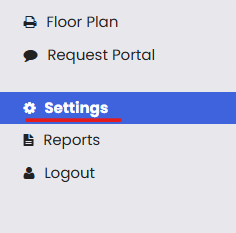
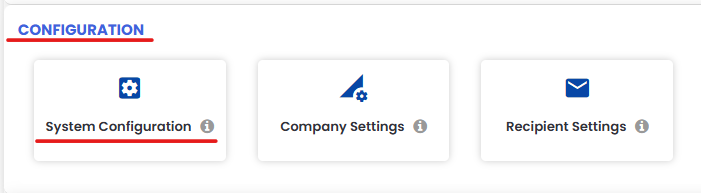
From the main menu, click Settings. Under the Configuration section, click System Configuration.
Step 2 – Open the Invoice Configuration Tab
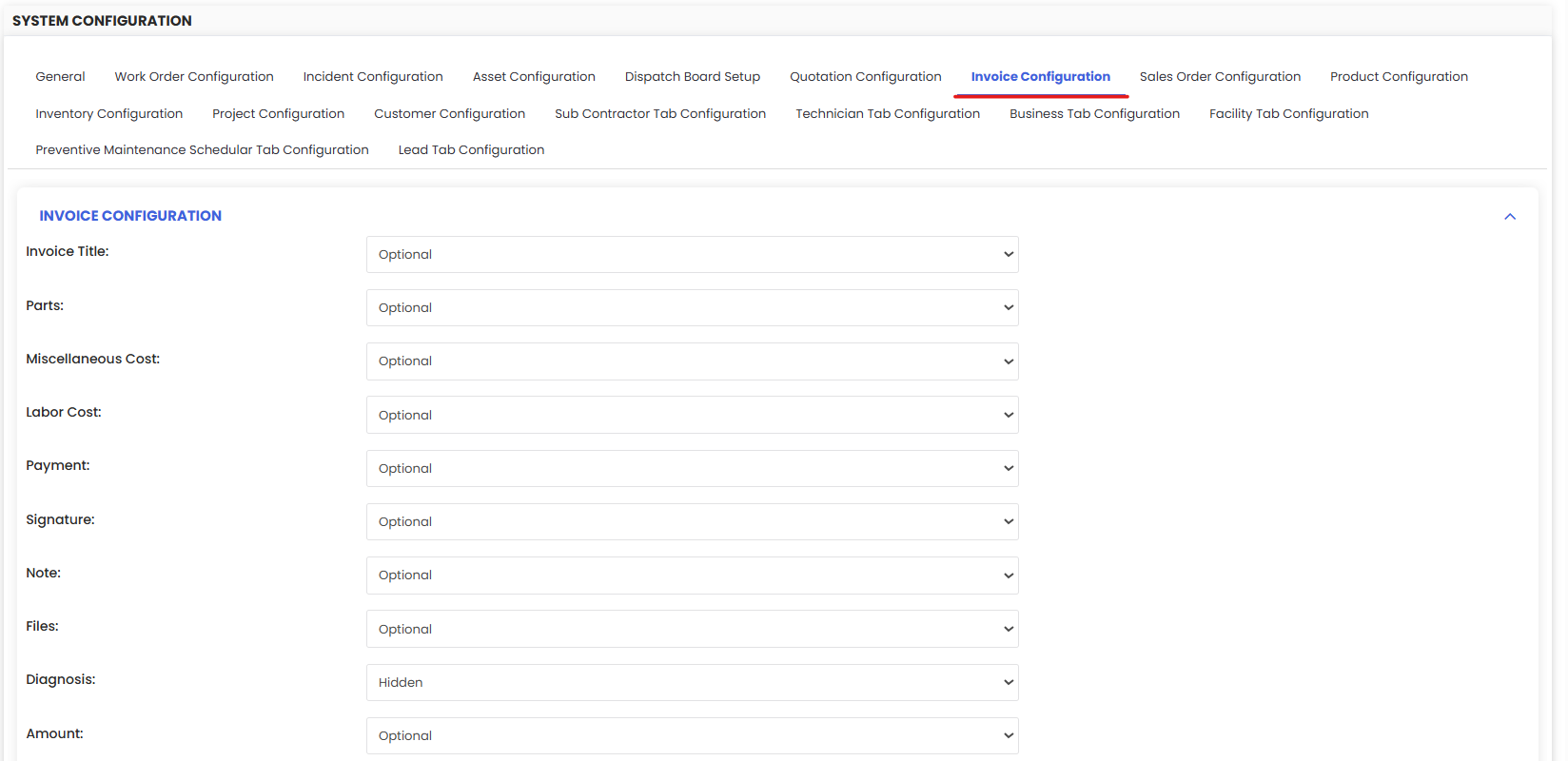
On the System Configuration page, click the Invoice Configuration tab. This tab contains all three configuration sections.
Step 3 – Configure the Invoice Form Fields
In the Invoice Fields Configuration section, review each field and set it to the appropriate state:
- Required — if the field must be completed before saving
- Optional — if the field should be visible but not mandatory
- Hidden — if the field should not appear on the form at all
Work through all fields, including any Custom Fields your organisation uses.
Step 4 – Configure Invoice Inventory Line-Item Details
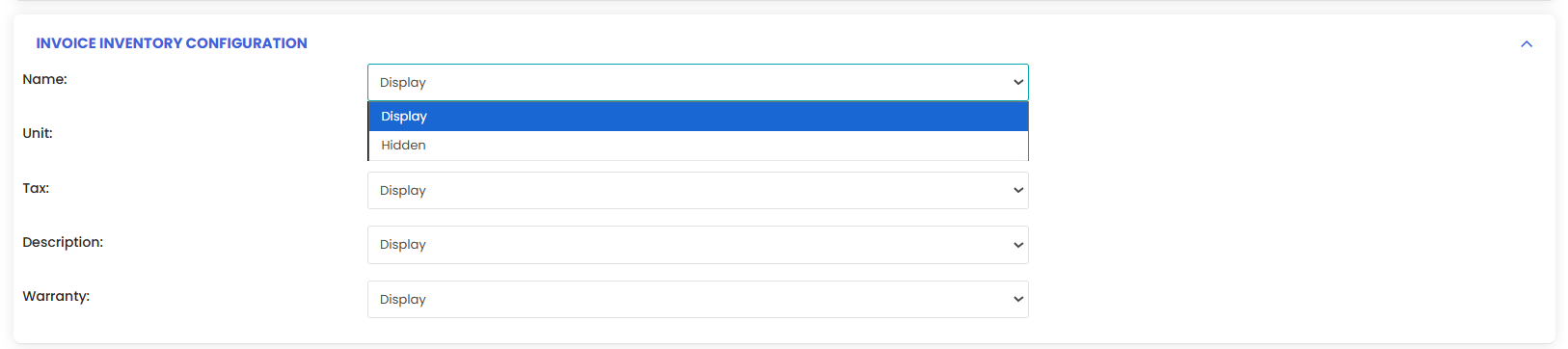
In the Invoice Inventory Configuration section, set each line-item detail to either:
- Display — visible on the invoice line items
- Hidden — not shown on the invoice
Step 5 – Configure the Invoice List Columns
In the Invoice Columns Configuration section, select which columns to display in the Invoice list view and set their display order so the most relevant information appears first.
Step 6 – Save Your Configuration
Once all three sections are configured, click Save. Changes take effect immediately for all users across the system.
Important: Changes apply immediately after saving. All users will see the updated invoice form, line-item display, and list view straight away. Communicate significant changes to your team before saving.
Recommended Configurations
Standard Customer Invoice
For invoices sent to external customers requiring full cost transparency:
- Required: Invoice Title, Parts, Labor Cost, Amount, Signature
- Optional: Misc. Cost, Payment, Note, Files, Diagnosis
- Hidden: (unused Custom Fields)
- Line Items: Display Name, Unit, Tax, Description | Hide Warranty
Internal Cost Record (No Customer Billing)
For internal maintenance cost tracking without customer-facing output:
- Required: Parts, Labor Cost, Amount
- Optional: Misc. Cost, Note, Diagnosis, Files
- Hidden: Invoice Title, Signature, Payment
- Line Items: Display Name, Unit | Hide Tax, Description, Warranty
Full Compliance Invoice
For organisations with strict financial or audit requirements:
- Required: Invoice Title, Parts, Labor Cost, Misc. Cost, Payment, Amount, Signature, Diagnosis
- Optional: Note, Files
- Hidden: (none)
- Line Items: Display all — Name, Unit, Tax, Description, Warranty
After Configuring — What's Next?
With your invoice configuration in place, you can:
- Create and manage invoices using the tailored, correctly enforced form
- Convert a Quotation to an Invoice once a quotation has been approved — see Convert a Quotation to an Invoice
- Configure Quotation Fields to apply consistent controls across the full quotation-to-invoice workflow
Tips for Configuring Invoice Fields
- Always require an amount and at least one cost field. An invoice without a value is incomplete — ensure Amount, Labor Cost, or Parts is Required to maintain billing accuracy.
- Use Signature for formal customer approval. If invoices require sign-off before payment, set Signature to Required to enforce this at the form level.
- Keep customer-facing line items clean. Only display line-item details that are meaningful to the customer. Hiding internal fields like Warranty from the invoice output keeps documents professional and concise.
- Align list columns with your billing review process. Surface Status, Amount, and Reconciled prominently so your finance team can quickly identify outstanding or unpaid invoices.
- Label Custom Fields clearly before marking them Required, so users know exactly what information to enter when creating an invoice.
- Review periodically. As your billing processes evolve, revisit the configuration to ensure it still matches your financial and compliance requirements.
Frequently Asked Questions
Who can change the Invoice Fields Configuration?
Only users with Admin permissions can access System Configuration and modify invoice fields, inventory, or column settings.
Do changes apply immediately after saving?
Yes. All changes take effect immediately across the invoice form, line-item display, and list view for all users.
Will hiding a field delete existing data in that field?
No. Setting a field to Hidden removes it from the form going forward but does not affect any data already saved in that field on existing invoices.
What is the difference between Invoice Fields Configuration and Invoice Inventory Configuration?
Invoice Fields Configuration controls the overall invoice form fields (e.g., Labor Cost, Signature, Payment). Invoice Inventory Configuration controls the details shown for each individual line item listed on the invoice (e.g., whether Tax or Warranty is displayed per item).
Does the Columns Configuration affect printed or exported invoices?
No. The Columns Configuration only affects the list view within DreamzCMMS. Printed and exported invoice documents have their own layout settings.